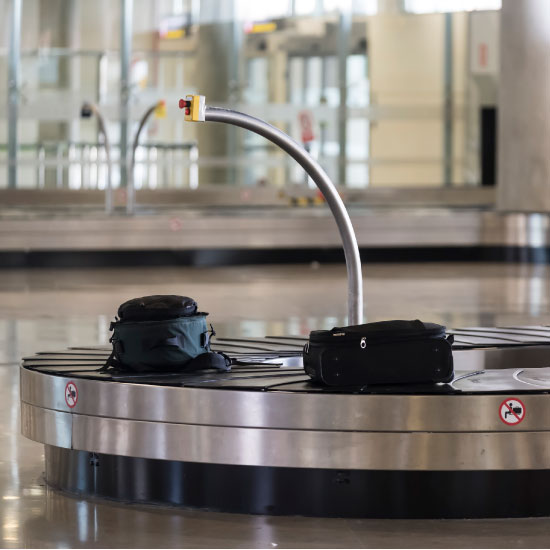

Early Baggage Storage
High-density automated baggage staging systems — BTS lane-based and ASRS crane-shuttle — that hold early check-in bags securely and inject them into make-up on schedule.
Early baggage storage (EBS) solves a structural airport operations problem: passengers check in hours before their flight departs, but the make-up belts for that flight are not active until the window opens. Without a managed intermediate store, early bags clog the conveyor network, create sort-error risk, and demand manual labour to hold and re-induct. Daifuku's EBS range addresses this with two automation architectures sized to different throughput and space envelopes.
The Baggage Tray System (BTS) is a lane-based automated store where each bag rides in a dedicated tray on a high-speed conveyor network. At 36 km/h conveying speed — among the highest published for any airport baggage tray system — the BTS handles induction and retrieval at a rate that keeps pace with the main BHS sortation loop without creating a bottleneck at the storage interface. Tray dimensions accommodate bags up to 750 mm × 1,000 mm × 650 mm and 50 kg per piece. The ASRS crane-and-shuttle variant adds vertical storage density, deploying high-speed stacker cranes in racked aisles to maximise bags-per-square-metre in terminals where floor area is the binding constraint — a common condition in GCC airports where basement BHS plant is competed for by infrastructure serving large terminal expansions.
The Dynamic Bag Buffer (DBB) extends the range with a robotic autonomous option that transfers bags between the conveyor and the storage facility without manual handling. RFID integration runs through all variants, providing 100% tracking and traceability at every storage and retrieval event. The system holds bags for any required dwell period — there is no practical upper limit on storage duration — and injects them back into the make-up flow at the flight's prescribed sortation time, driven by the BHCS control system. For long-haul hubs with six-to-twelve-hour early check-in windows, the combination of tray-based precision retrieval and RFID-verified identity effectively eliminates the manual bag-hunt labour that characterises high-dwell operations.
Technical specifications.
| BTS conveying speed | 36 km/h |
| Maximum bag dimensions (BTS tray) | 750 × 1,000 × 650 mm (W × L × H) |
| Maximum bag weight (BTS) | 50 kg |
| Tray size | 850 × 1,200 mm (W × L) |
| Storage duration | Indefinite (flight-schedule driven retrieval) |
| Traceability | 100% RFID throughout BHS |
| ASRS crane fleet experience | >40,000 cranes deployed worldwide |
| Automation types | BTS lane-based, ASRS crane-shuttle, Dynamic Bag Buffer (DBB) |
Use cases.
- ›Long-haul hub terminals with multi-hour early check-in windows where bags must be held and injected on schedule without manual buffering
- ›High-throughput airports where early bags would otherwise crowd the main sort loop and degrade peak-period BHS performance
- ›Space-constrained basement BHS plants requiring vertical ASRS storage to maximise bag capacity per square metre
- ›Airports with RFID-mandatory IATA 753 tracking requirements needing continuous chain-of-custody through the storage layer
- ›Transfer hub operations managing short-connection re-routing where rapid ASRS retrieval is critical to on-time bag delivery
- ›New terminal designs where the EBS system is integrated into the BHS from the design phase to enable a clean, flow-based operation
Replacements & compatible alternatives.
Comparable Baggage Handling Systems from other suppliers. Cross-shop on specs — confirm exact fit and compatibility with the supplier before specifying.