GP-Cloud
Centralized web platform for real-time GNSS interference detection, classification and TDOA localization across probe networks
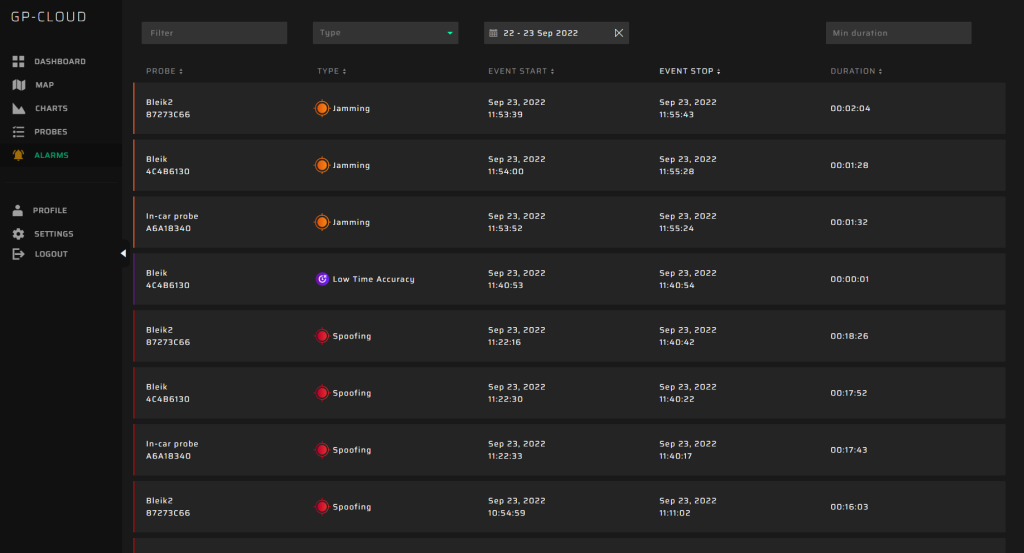
GP-Cloud is GPSPATRON's web platform for centralized, real-time GNSS signal quality analysis, interference detection and classification across an entire GNSS-dependent infrastructure. GP-Probes deployed at monitored sites stream measurements of all visible satellites to GP-Cloud, where detection algorithms process the data in real time; when spoofing, jamming or signal quality degradation is identified, the platform notifies operators and can signal the probe to act.
The platform detects and classifies the full published attack taxonomy — asynchronous spoofing, synchronous spoofing, synchronous multiple-transmitter spoofing (with three-channel GP-Probe TGE2 hardware), and spoofing combined with jamming — alongside jamming, anomalies, PPS offset, low position accuracy, offline and hardware-error events. Interference is classified via modulation feature analysis of the RF spectrum, with spectrogram visualization from TGE2 probes, and localized using TDOA processing of raw IQ data from multiple probes. Over 40 satellite parameters (pseudorange, carrier phase, Doppler, CN0, DOPs and more) are logged for post-incident analysis, with 12-month event storage and measurement retention from 14 days (Base) to custom periods (Enterprise).
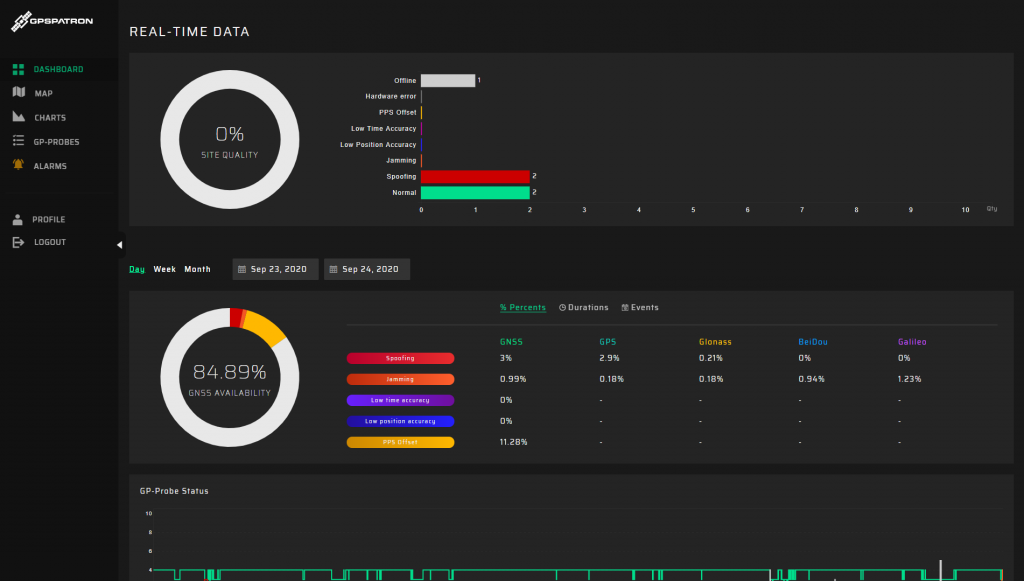
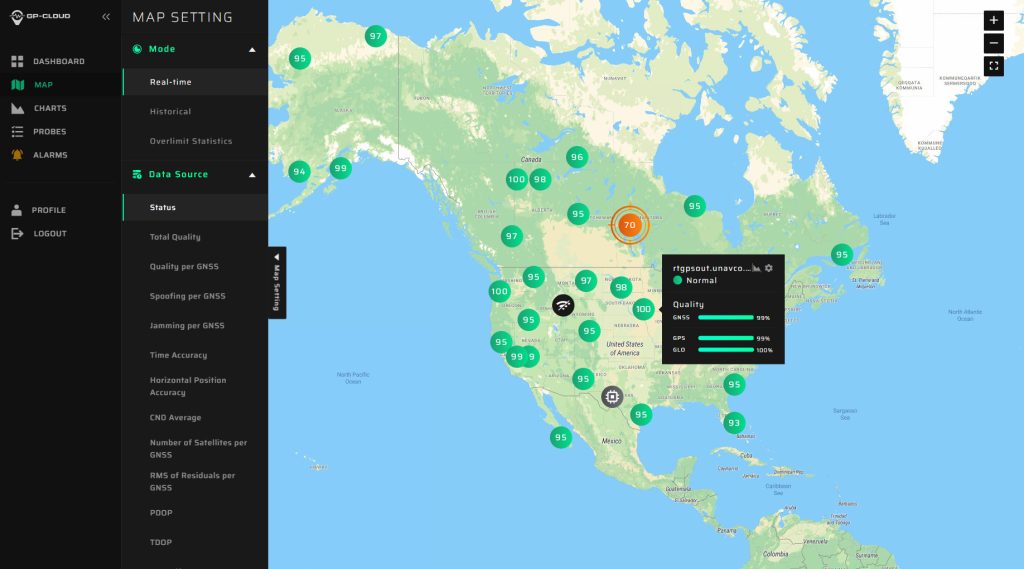
Operators work from real-time dashboards with probe status, event statistics, an interactive infrastructure map, satellite heat maps and 15+ chart types including power-in-band, spectrogram and PPS offset. Alerting is delivered via email, webhooks and RabbitMQ, and a Swagger-documented REST API supports integration into existing network management systems. Beyond GPSPATRON's own GP-Probe TGE2 and GP-Probe DIN L1, GP-Cloud ingests data from third-party GNSS receivers via RTCM@NTRIP, NMEA@NTRIP, Septentrio SBF and u-blox UBX protocols.
GP-Cloud is offered as a cloud service or as an on-premises deployment: the on-premises Base edition runs on a single server supporting up to 8 GP-Probe TGE2 or 16 DIN L1 units, while Enterprise adds multi-instance clustering, unlimited probes, active-active redundancy, database clustering and zero-downtime backups. Published applications span time synchronization monitoring, critical infrastructure threat detection, RTK base station monitoring and nation-wide interference monitoring deployments — the aggregation layer for an airport-wide or national GNSS interference monitoring network.
Technical specifications.
| Function | Real-time GNSS interference detection, classification, TDOA localization and signal quality analytics |
| GNSS constellations | GPS, GLONASS, BeiDou, Galileo |
| Detectable events | Spoofing, jamming, anomaly, interference, PPS offset, low position accuracy, offline, hardware error (varies by probe type) |
| Spoofing scenarios covered | Asynchronous, synchronous, synchronous multiple-TX (with TGE2), spoofing combined with jamming |
| Interference classification | Modulation feature analysis of RF spectrum; spectrogram visualization (TGE2) |
| Interference localization | TDOA using raw IQ data from multiple probes |
| Logged parameters | 40+ satellite parameters: pseudorange, carrier phase, Doppler, CN0, DOPs, and more |
| Data retention | 14-day measurement storage (Base); 12-month event storage; custom periods and raw GNSS retention (Enterprise) |
| Dashboards | Real-time probe status, event statistics, interactive map, satellite heat maps, 15+ chart types |
| Deployment | Cloud (Base/Enterprise) or on-premises (Base/Enterprise) |
| On-premises capacity (Base) | Single server, up to 8 GP-Probe TGE2 or 16 GP-Probe DIN L1 |
| On-premises Enterprise | Multi-instance clustering, unlimited probes, active-active redundancy, database clustering, zero-downtime backups |
| Supported GPSPATRON probes | GP-Probe TGE2 (3-channel), GP-Probe DIN L1 |
| Third-party receiver support | RTCM@NTRIP, NMEA@NTRIP, Septentrio SBF, u-blox UBX |
| Alerting channels | Email, webhooks, RabbitMQ |
| API | REST API with Swagger documentation |
Available variants.
Use cases.
- ›nation-wide and airport-wide GNSS interference monitoring
- ›time synchronization integrity monitoring
- ›GNSS spoofing incident forensics
- ›RTK base station monitoring
Replacements & compatible alternatives.
Comparable Air Traffic Control & Navigation Aids from other suppliers. Cross-shop on specs — confirm exact fit and compatibility with the supplier before specifying.