GP-Probe TGE2
Three-channel GNSS spoofing and jamming detection probe with real-time RF spectrum analysis for timing-critical infrastructure
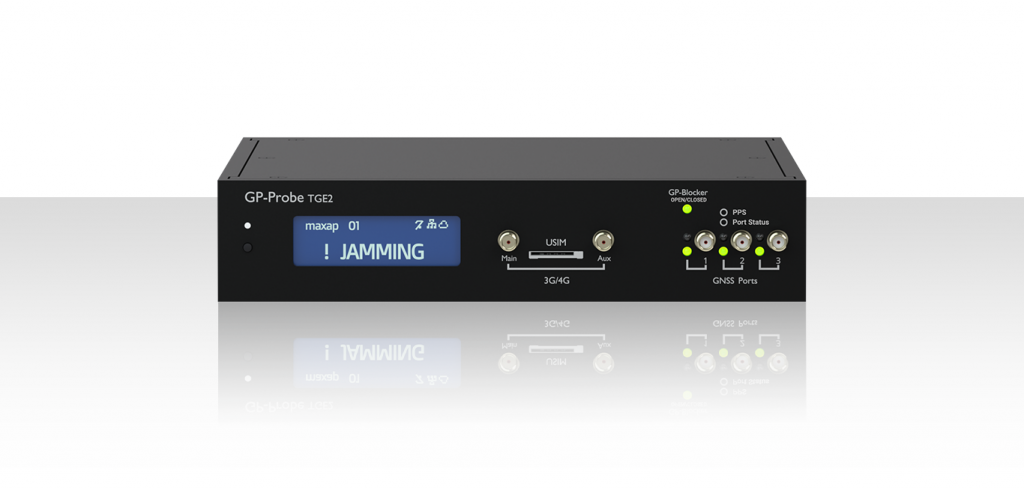
The GP-Probe TGE2 (Time Guard Edition 2) is a three-channel GNSS probe with a built-in real-time RF signal analyzer, designed to protect time servers and PNT infrastructure against GNSS threats including intentional spoofing, jamming, ionospheric scintillation and system errors. It measures GNSS satellite signals on three independent RF channels and transmits raw data to the GP-Cloud platform for real-time processing, classification and alerting; an Onboard Signal Processing (OSP) option lets the probe detect spoofing without any cloud connection.
Detection capability scales with channel count: one channel detects asynchronous spoofing, two channels detect synchronous spoofing, and three channels — using spatial signal analysis across GNSS antennas spaced 0.25 m to 5 m apart — provide assured detection of synchronous multiple-transmitter spoofing, the most sophisticated attack scenario. All types of jamming are detected by the embedded 60 MHz real-time RF signal analyzer (1555–1615 MHz, 12-bit 60 MSPS ADC, 122 dB AGC dynamic range, OCXO 50 ppb reference), which supports spectrum monitoring, interference classification, and interference localization by TDOA when raw IQ data is streamed to GP-Cloud.
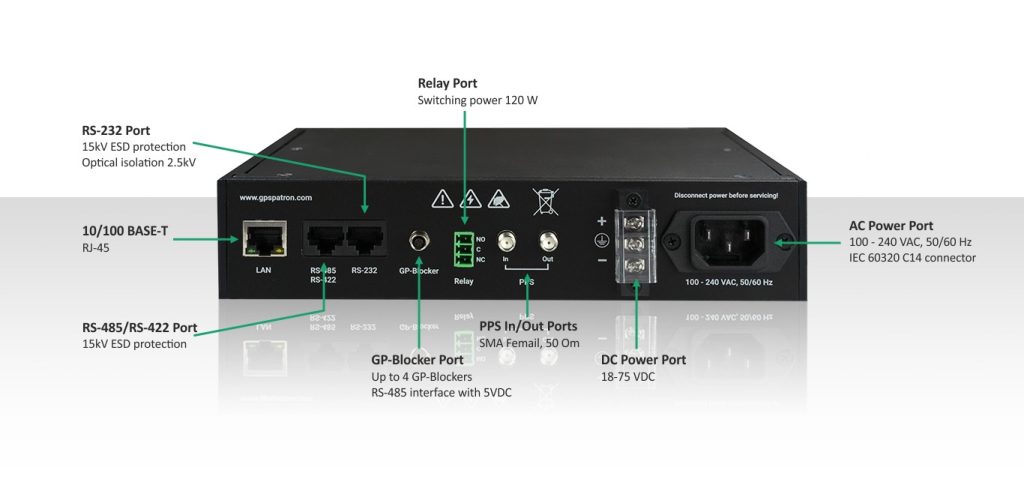
The probe monitors GPS/QZSS L1 C/A, GLONASS L1OF, BeiDou B1, Galileo E1B/C and SBAS L1 C/A (WAAS, EGNOS, MSAS, GAGAN). A PPS input measures the time offset between internal and external PPS to continuously check the health of a connected time server, and a PPS output (< ±20 ns RMS to UTC(USNO), clear sky) can synchronize external equipment. On detection, the probe can switch a Form C relay, control external equipment over RS-232/RS-485/RS-422 using its embedded Lua scripting engine (for example, commanding a time server into holdover), or drive up to four optional GP-Blockers to isolate the antenna feed from counterfeit signals.
Housed in a 1U half-size 19-inch rack unit with a dual power module (100–240 VAC and 18–75 VDC, under 20 W) and running the FreeRTOS real-time operating system for high availability and cybersecurity, the TGE2 is built for 24/7/365 operation. Typical deployments place probes at GNSS-dependent timing nodes across an airport or telecom network, with data aggregated in GP-Cloud over Ethernet or the optional built-in 3G/4G modem.
Technical specifications.
| GNSS signals monitored | GPS/QZSS L1 C/A; GLONASS L1OF; BeiDou B1; Galileo E1B/C; SBAS L1 C/A (WAAS, EGNOS, MSAS, GAGAN) |
| GNSS RF channels | 3 (spatial analysis for synchronous multi-TX spoofing detection) |
| Detected threat types | All types of jamming; asynchronous spoofing (1 ch); synchronous spoofing (2 ch); synchronous multiple-TX spoofing (3 ch) |
| RF signal analyzer bandwidth | 60 MHz |
| RF analyzer frequency range | 1555–1615 MHz |
| ADC | 12-bit, 60 MSPS |
| Noise figure | 6 dB max |
| AGC dynamic range | 122 dB (−31 to +91 dB gain) |
| Local oscillator | OCXO, 50 ppb; phase noise −154 dBc/Hz @ 10 kHz |
| Measured RF parameters | Power in band per constellation; 128/1024-point power spectrum; 128×509-point spectrogram @ 273 µs |
| Recommended antenna spacing | 0.25–5 m |
| Cellular option | Built-in 3G/4G modem (LTE CAT1), mini-SIM (2FF) |
| Operating system | FreeRTOS real-time OS |
| PPS output accuracy (clear sky) | < ±20 ns RMS to UTC(USNO), typical |
| PPS input | SMA(F), 50 Ω TTL-compliant, 1.3–5.5 V |
| GNSS antenna inputs | SMA(F), 50 Ω, 3.3 VDC bias, ±15 kV ESD protection (IEC 61000-4-2) |
| Network interface | 10/100BASE-T RJ45; HTTPS to GP-Cloud; IPv4/DHCP |
| Serial interfaces | RS-232 and RS-485/RS-422 HOST ports, optically isolated, ±15 kV ESD, Lua-scripted control |
| Relay output | 1 Form C (SPDT), 2 A, 60 W/125 VA, 220 VDC/250 VAC |
| GP-Blocker port | RS-485, 9600 bps, up to 4 GP-Blockers |
| Power supply | Dual module: 100–240 VAC 50/60 Hz and 18–75 VDC |
| Power consumption | < 20 W |
| Housing | Aluminium, IP20 |
| Operating temperature | 0 to +50 °C |
| Humidity | 0–90% RH non-condensing @ 40 °C |
| Form factor | 19-inch rack, 1U half-size, 211 × 203 × 44 mm |
| Weight | 1.5 kg |
| Warranty | 1 year (extended available), 1 year complimentary support |
Available variants.
Certifications.
Use cases.
- ›airport GNSS interference and spoofing monitoring
- ›time server and network synchronization protection
- ›GNSS threat detection for critical infrastructure
- ›TDOA interference localization
Replacements & compatible alternatives.
Comparable Air Traffic Control & Navigation Aids from other suppliers. Cross-shop on specs — confirm exact fit and compatibility with the supplier before specifying.