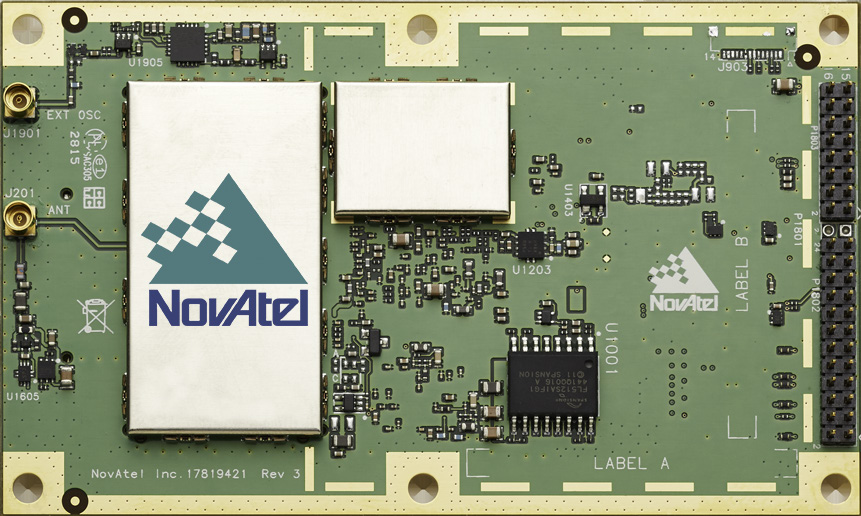
NovAtel OEM729 GNSS Receiver Board
Multi-frequency, all-constellation OEM7 receiver board with GRIT interference and spoofing detection and external oscillator input
The OEM729 is NovAtel's multi-frequency GNSS receiver board for integrators - the OEM7 engine that puts GRIT interference and spoofing detection inside your own monitoring node, timing appliance or airside system. In a 60 x 100 x 9 mm, 48 g card that is form-factor and pin-compatible with the previous-generation OEM628 - making it a drop-in modernisation path for fielded systems - it tracks all current and upcoming constellations: GPS (L1 C/A, L1C, L2C, L2P, L5), GLONASS, Galileo (E1, E5 AltBOC, E5a, E5b, E6), BeiDou (B1I, B1C, B2I, B2a, B2b, B3I), QZSS, NavIC and SBAS, with up to five L-Band channels for TerraStar corrections. Advanced interference mitigation features maintain high performance in challenging RF environments: spoofing detection, interference detection and mitigation are provided by NovAtel's GNSS Resilience and Integrity Technology (GRIT) firmware, complemented by Receiver Autonomous Integrity Monitoring (RAIM). Two features make the OEM729 particularly suited to fixed monitoring and timing infrastructure: a dedicated external oscillator input (MMCX) for disciplining against a site frequency standard, and <5 ns RMS time accuracy with PPS output and Precision Time Protocol (PTP) support.
Positioning scales from 1.5 m single point through 40 cm DGPS to 1 cm + 1 ppm RTK and 2 cm TerraStar PPP, at up to 100 Hz. Integration options include RS-232/RS-422 and LVCMOS serial, dual CAN, USB 2.0 and 10/100 Ethernet with web GUI; differential support covers RTCM 2.x/3.x, CMR/CMR+, RTCA and NOVATELX, with NMEA 0183 and NovAtel ASCII/binary log output. Power draw is 0.9-1.8 W typical at 3.3 VDC. The board is rated -40 C to +85 C operating and tested to MIL-STD-810G vibration (Cat 24, 20 g RMS), operating shock (40 g) and acceleration (16 g).
OEM7 firmware options are field-upgradeable - GRIT, RTK, ALIGN heading, GLIDE, STEADYLINE and SPAN GNSS+INS - so an OEM729-based interference monitor can be re-scoped as requirements grow. FCC, ISED, CE and global type approvals are held.
Technical specifications.
| Signal tracking | GPS L1 C/A, L1C, L2C, L2P, L5; GLONASS L1 C/A, L2 C/A, L2P, L3, L5; Galileo E1, E5 AltBOC, E5a, E5b, E6; BeiDou B1I, B1C, B2I, B2a, B2b, B3I; QZSS L1 C/A, L1C, L1S, L2C, L5, L6; NavIC L5; SBAS L1/L5; up to 5 L-Band channels |
| GNSS resilience | spoofing detection, interference detection and mitigation provided by GRIT; Receiver Autonomous Integrity Monitoring (RAIM) |
| Horizontal position accuracy (RMS) | 1.5 m single point L1; 1.2 m single point L1/L2; 40 cm DGPS; RTK 1 cm + 1 ppm; TerraStar-C PRO / TerraStar-X 2 cm (subscription) |
| Time accuracy | <5 ns RMS; velocity accuracy <0.03 m/s RMS; data rate up to 100 Hz (measurements and position) |
| Time to first fix | cold start <34 s (typ), hot start <20 s (typ); signal reacquisition L1 <0.5 s, L2 <1.0 s (typ) |
| Differential corrections | RTCM 2.1/2.3/3.0/3.1/3.2/3.3, CMR, CMR+, RTCA, NOVATELX; NMEA 0183 and NovAtel ASCII/binary logs |
| Physical | 60 x 100 x 9 mm, 48 g; form-factor and pin-compatible with previous-generation OEM628; MMCX antenna input |
| Field-upgradeable OEM7 firmware options | GRIT, RTK, ALIGN heading, GLIDE, STEADYLINE, SPAN GNSS+INS |
| External oscillator input | MMCX input for disciplined timing applications |
| Interfaces | 1x RS-232/RS-422 + 2x LVCMOS serial up to 460,800 bps, 2x CAN 1 Mbps, USB 2.0, 10/100 Ethernet with web GUI, 2 event inputs, 1 event output, PPS output |
| Power | 3.3 VDC +/-5%; 0.9 W (GPS L1 typ) to 1.8 W (all constellations/frequencies with L-Band, typ); antenna port 5 VDC, 200 mA max |
| Environmental | -40 C to +85 C operating, -55 C to +95 C storage; MIL-STD-810G vibration (Cat 24, 20 g RMS), operating shock 40 g, acceleration 16 g; IEC 60068-2-6, ISO 9022-31-06 bump |
Available variants.
Certifications.
Use cases.
- ›Embedded GNSS engine for fixed interference/spoofing monitoring nodes at airports and ANSP sites (GRIT + ITK logs)
- ›Timing receiver with external oscillator input for ATC, GBAS and airport network synchronisation
- ›Reference receiver integration in continuously-operating reference stations (CORS)
- ›OEM integration into airside vehicles, survey systems and UAV ground equipment requiring interference-resilient positioning
- ›Drop-in modernisation of existing OEM628-based airport systems to gain GRIT detection capability
Replacements & compatible alternatives.
Comparable Air Traffic Control & Navigation Aids from other suppliers. Cross-shop on specs — confirm exact fit and compatibility with the supplier before specifying.