McQ TNet Repeater and Base Station
Self-forming 900 MHz sensor mesh that relays UGS alarms and images beyond line of sight to any IP network, with built-in LTE backhaul.
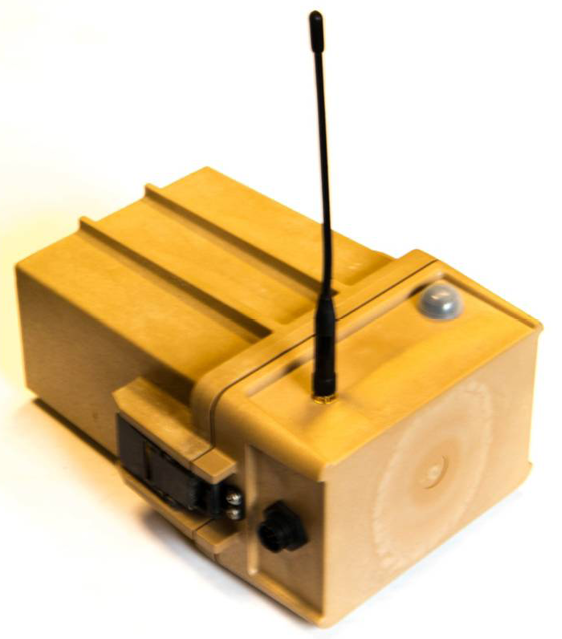
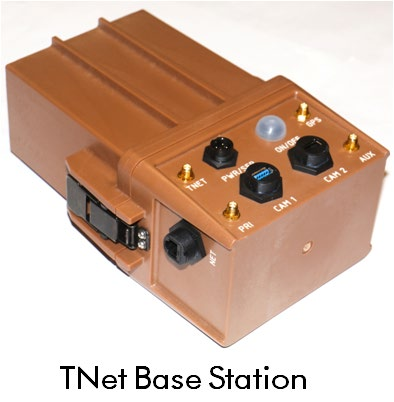
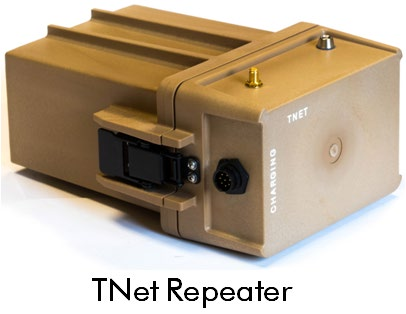
McQ TNet is the terrestrial RF backbone that connects McQ unattended ground sensors, radars and cameras to their operators when no direct line of sight exists between sensor field and command post. It is a self-forming 900 MHz spread-spectrum network: Repeater and Base Station units automatically recognise neighbouring sensors and repeaters, route message traffic, and guarantee delivery of target alarms and images through the repeater chain with very fast inbound alerting. Ten separate network channels allow multiple sensor networks to coexist, and encryption is available across the link. Both the rugged Base Station and Repeater units share an 8 x 6 x 3.75 inch weatherproof housing weighing 5.5 lb including one BA-series battery, with a built-in solar charge controller, external power and RS-232 connectors, internal GPS receiver with external antenna, and selectable tamper reporting. The Base Station bridges the sensor radio network onto any IP network via Ethernet TCP/IP and includes a built-in cellular LTE modem, feeding map-based user interfaces such as TacSAD or third-party common operating pictures; units can be configured locally or over the network. Designed around the very low power budgets of battery-powered UGS deployments, TNet extends RANGER, rScene and OWL coverage across long distances in border, pipeline and perimeter security networks.
The TNet design guarantees message delivery in both directions: inbound target detections and images pass instantaneously through the repeater chain, while outbound command-and-control messages are acknowledged so the operator knows they reached the intended unit. On the wire, TNet uses a TCP/IP message protocol carrying McQ's CDIF binary sensor message format, and the Base Station pushes XML, CoT, JSON or CDIF to other systems, linking RANGER sensors, rScene radars, OWL cameras and TacSAD (including the Android TacSAD Mobile via Bluetooth-connected wireless modem). Operators select one of the ten network channels per sensor network in the field; a Base Station can also serve as a Repeater. Units are offered in outdoor rugged and rack-mount forms.
Technical specifications.
| RF data modem | UHF 900 MHz spread spectrum |
| Alarm delivery | Inbound target detection messages delivered instantaneously through the repeater chain; outbound C2 messages with acknowledgement |
| Encryption | Available |
| GPS | Internal GPS receiver with external antenna |
| Tamper | Selectable tamper report configurations |
| Configuration | Configured over the network or locally |
| Network channels | 10 separate channels (one selectable per sensor network) |
| Network type | Self-forming; automatic neighbour recognition and message routing with guaranteed delivery |
| Base Station I/O | Ethernet TCP/IP, RS-232 serial, built-in cell LTE modem, external power connector |
| Repeater I/O | External power connector, RS-232 serial connector, AC or solar panel (relay-only unit; no Ethernet/LTE) |
| Data formats | TCP/IP message protocol; CDIF binary sensor message format; XML, CoT, JSON or CDIF output to other systems |
| Power | BA-series battery; external power, AC or solar panel; built-in solar charge controller |
| Weight (including one BA-series battery) | 5.5 lb |
| Form factors | Outdoor rugged units and rack-mount units |
| Size (Base Station / Repeater) | 8 x 6 x 3.75 in |
Available variants.
Use cases.
- ›unattended ground sensor network backhaul
- ›beyond-line-of-sight sensor communications
- ›border and pipeline sensor mesh networking
- ›perimeter sensor range extension
Replacements & compatible alternatives.
Comparable products from other suppliers. Cross-shop on specs — confirm exact fit and compatibility with the supplier before specifying.