
Snozzle High-Reach Extendable Turret (HRET)
A boom-mounted piercing and suppression system that lets an ARFF crew attack a fuselage fire from above without a crew entering the aircraft.
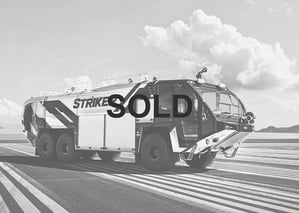
The Snozzle High-Reach Extendable Turret (HRET) is an articulating, vehicle-mounted system that mounts to the Striker ARFF platform and gives firefighters the ability to deliver suppression agent directly into an aircraft fuselage — through the skin — from outside the aircraft and at elevation. It is the defining ARFF capability for wide-body aircraft incidents where interior fires are inaccessible to standard turret streams and where sending crew inside a burning fuselage is not immediately viable.
The Snozzle is available in 50-foot (15.24 m) and 65-foot (19.81 m) boom configurations. At full extension, the 65-foot model provides a lateral sweep of 46 feet, allowing a single vehicle to cover the full width of a wide-body fuselage from one side. A 60-degree rotation arc and proportional joystick controls allow the operator to position the tip with precision while seated in the cab. The hardened carbide-steel piercing tip penetrates aircraft skin to a depth of 36 inches (915 mm) standard, extendable to 48 inches (1,219 mm) with an optional extension — sufficient to reach into cargo compartments and fuselage interiors. The tip rotates 280 degrees, enabling the operator to disperse agent across up to two aisles of a wide-body aircraft from a single pierce point.
Flow rates depend on the host vehicle: 375–750 gpm on the 4x4 platform, 500–1,000 gpm on the 6x6. The head is 24 inches wide, easing placement between wings and ground equipment on congested ramps. Sensor options include colour, black-and-white, and Forward Looking Infrared (FLIR) thermal cameras, feeding a cab display so the operator can locate hidden fire sources before and during penetration. ClearSky Intelligence maintenance telematics are integral to Striker vehicles that carry the Snozzle.
For GCC operators running wide-body-heavy schedules — including A380, B777, and A350 fleets at hubs like Dubai, Abu Dhabi, and Doha — the Snozzle converts a standard ARFF vehicle into a fuselage-penetration platform without requiring a second specialist unit.
Technical specifications.
| Boom Configurations | 50 ft (15.24 m) and 65 ft (19.81 m) |
| Lateral Sweep — 50 ft model | 36 ft (11.2 m) |
| Lateral Sweep — 65 ft model | 46 ft (14 m) |
| Boom Rotation Arc | 60 degrees |
| Tip Rotation | 280 degrees |
| Piercing Depth (standard) | 36 in (915 mm) |
| Piercing Depth (with extension) | 48 in (1,219 mm) |
| Head Width | 24 in (610 mm) |
| Flow Rate — 4x4 host | 375–750 gpm (1,420–2,840 lpm) |
| Flow Rate — 6x6 host | 500–1,000 gpm (1,893–3,786 lpm) |
| Piercing Tip Material | Hardened carbide steel |
| Camera Options | Colour, B/W, FLIR thermal |
| Agent Compatibility | Water, foam, clean agent |
Use cases.
- ›Fuselage-penetration fire attack on wide-body aircraft (A380, B777, A350, B747) where interior fires are inaccessible to exterior streams
- ›Cargo compartment suppression — the extended tip can reach inside Class C/E cargo holds through the aircraft skin
- ›Elevated approach to fires in the upper deck or crown of double-deck aircraft without aerial platform equipment
- ›Category 9/10 hub operations where ICAO Annex 14 or national regulations mandate HRET capability for aircraft above a specified MTOW threshold
- ›Night and smoke-degraded-visibility operations using the integrated FLIR thermal camera for heat-source localisation before pierce
- ›Retrofit enhancement to existing Striker 4x4 or 6x6 fleets to extend their operational capability envelope without full vehicle replacement
Replacements & compatible alternatives.
Comparable Fire Safety & Rescue from other suppliers. Cross-shop on specs — confirm exact fit and compatibility with the supplier before specifying.