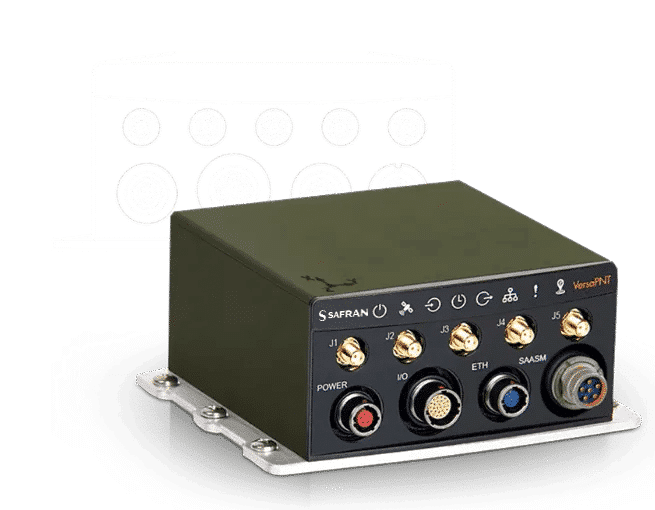
VersaPNT Assured Positioning, Navigation & Timing Unit
Compact rugged GNSS + inertial sensor-fusion unit — navigation system, master clock and NTP/PTP time server in one 1 kg IP65 box
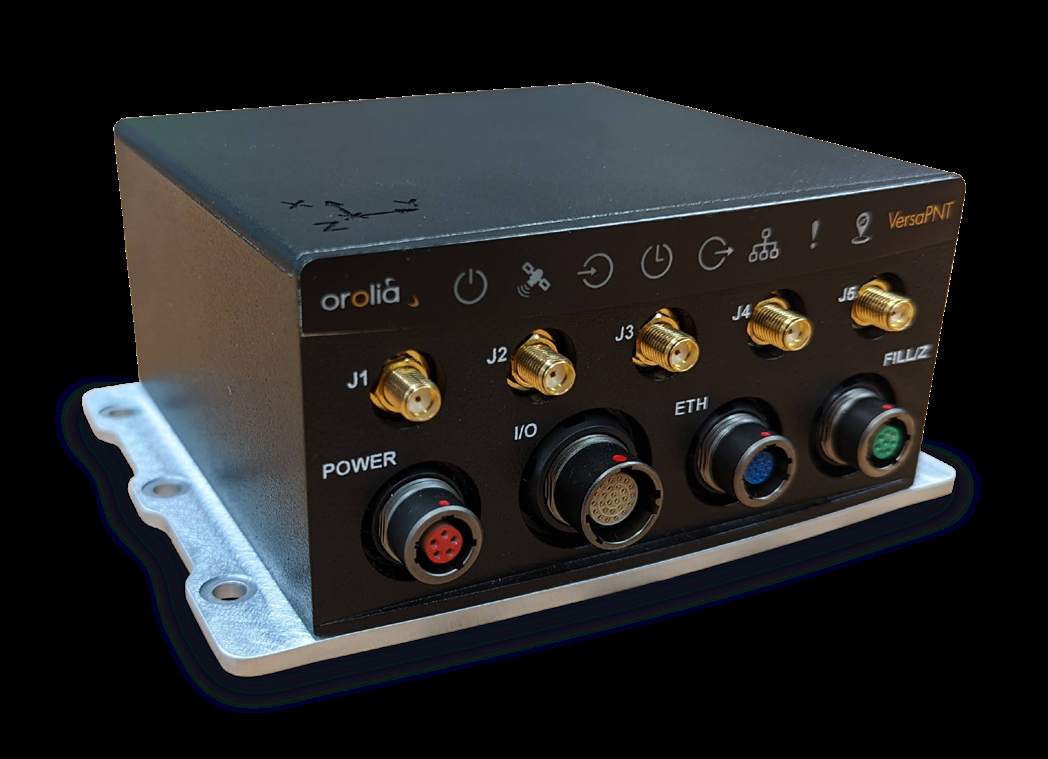
VersaPNT is a compact, rugged assured-PNT platform that fuses multi-constellation GNSS, an internal tactical-grade MEMS inertial measurement unit and a high-stability oscillator through Safran's FlexFusion sensor-fusion engine, so position, navigation and timing outputs continue through GNSS-disrupted or denied conditions. It combines functions normally spread across several subsystems — GPS-aided inertial navigation system, master clock, and NTP/PTP network time server — in a single VITA 75 conduction-cooled unit of 147.3 x 127.5 x 63.0 mm and 1.0 kg, drawing under 25 W from a 10-32 VDC supply (0.4 W oscillator-only standby). Oscillator options are OCXO, high-performance OCXO or the mRO-50 miniature rubidium: locked to GNSS, 1PPS accuracy to UTC is +/-50 ns, and in holdover the mRO-50 keeps 1PPS drift to 0.2 us after 4 hours, 1.5 us after 24 hours and 20 us after 7 days with no reference available.
Navigation performance (typical clear-sky) is 2.5 m RMS horizontal / 5.0 m RMS vertical position, +/-0.05 m/s velocity, <0.03 deg RMS roll/pitch and <0.2 deg RMS heading with GPS, streamed at a 400 Hz output rate over serial or LAN. Embedded GNSS jamming/spoofing detection is available as an option, and the unit is compatible with anti-jam (AJAS/CRPA) antennas and external IMUs. Timing I/O covers 1PPS, IRIG DCLS timecodes, 10 MHz sine, NMEA 0183 and HaveQuick, plus NTP v2/v3/v4 and PTP IEEE 1588 master over dual Gigabit Ethernet, with SNMP v2/v3, JSON RPC and a web UI for management.
Ruggedised to MIL-STD-810G, MIL-STD-461F EMI/EMC and IP65, operating from -40 to +71 C (OCXO), it suits airfield and mobile deployments where fixed timing infrastructure is absent: airside operations and inspection vehicles, deployable or temporary installations, UAS ground support and survey platforms. The standard commercial variant uses a 72-channel GNSS L1 receiver; restricted SAASM/M-Code variants are export-controlled for authorised government users and are not offered here.
Technical specifications.
| Sensor fusion | FlexFusion engine combining GNSS + internal tactical-grade MEMS IMU + precision oscillator; external IMU and alternative-navigation inputs supported |
| GNSS | 72-channel L1 receiver, multi-constellation capability; SMA input with +5 VDC antenna feed; AJAS anti-jam antenna compatible |
| Oscillator options | OCXO, high-performance OCXO, mRO-50 miniature rubidium |
| 1PPS accuracy to UTC (locked) | +/-50 ns; frequency accuracy 5x10^-12 (OCXO) to 1x10^-12 (mRO-50) averaged over 24h |
| Holdover 1PPS drift (mRO-50) | 0.2 us @ 4 h, 1.5 us @ 24 h, 20 us @ 7 days; (OCXO): 3 us @ 4 h, 40 us @ 24 h |
| Position accuracy | 2.5 m RMS horizontal, 5.0 m RMS vertical (GPS L1, typical); velocity +/-0.05 m/s; heading <0.2 deg RMS with GPS; 400 Hz nav output rate |
| Operational readiness (hot start) | 1 ms UTC accuracy in 60 s, 1 us in 200 s |
| GNSS jamming/spoofing detection | optional embedded |
| Environment | -40 to +71 C operating (OCXO; -10 to +45 C mRO-50), IP65, MIL-STD-810G shock/vibration, MIL-STD-461F EMI/EMC, 45,000 ft altitude |
| Timing I/O | 1PPS, configurable pulses to 10 MHz, IRIG DCLS (A/B/E/G, NASA-36), HaveQuick, NMEA 0183 over RS-232/RS-485, 10 MHz sine (SMA) |
| Network | NTP v2/v3/v4 server, PTP IEEE 1588 v1/v2 master, dual 10/100/1000bT; SNMP v2/v3, JSON RPC, HTTPS web management |
| Power | 10-32 VDC, <25 W typical (OCXO), 0.4 W standby; size 147.3 x 127.5 x 63.0 mm VITA 75; weight 1.0 kg |
| Ordering / variants | Oscillator: OCXO / high-performance OCXO / mRO-50 mini-rubidium (rugged low-phase-noise OCXO option for high-vibration platforms); optional internal option board for additional RS-232/RS-485/DCLS interfaces; optional embedded jamming/spoofing detection; optional VICTORY interface; external IMU input. SAASM and M-Code receiver variants are export-controlled (authorised government users only) and excluded from this listing. |
Certifications.
Use cases.
- ›Timing and navigation for airside operations, inspection and follow-me vehicles
- ›Deployable/temporary airport installations needing a local master clock and NTP/PTP server
- ›UAS and survey platform PNT in GNSS-degraded environments
- ›Mobile communications and sensor networks requiring 1PPS/10 MHz/IRIG references
- ›Resilient PNT where GNSS outages must be bridged by inertial + rubidium holdover
Replacements & compatible alternatives.
Comparable Air Traffic Control & Navigation Aids from other suppliers. Cross-shop on specs — confirm exact fit and compatibility with the supplier before specifying.