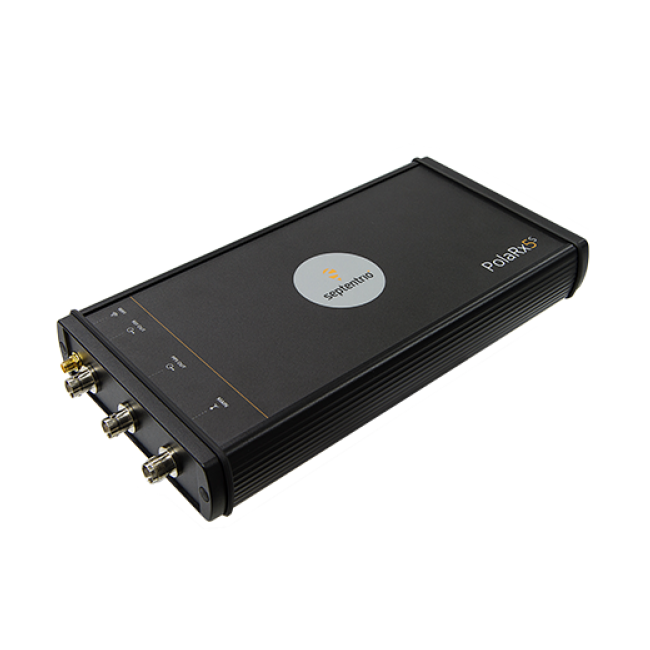

Septentrio PolaRx5S Ionospheric Monitoring GNSS Reference Receiver
Scintillation and interference monitoring reference receiver with 100 Hz output, real-time TEC/scintillation indices and AIM+ RF spectrum monitoring
The PolaRx5S is Septentrio's dedicated ionospheric monitoring GNSS reference receiver — the instrument the company positions for scintillation, space-weather and signal-integrity monitoring networks. Its 544-channel engine tracks all visible signals across the full GNSS spectrum — GPS (L1, L2, L5), GLONASS (L1, L2, L3), Galileo (E1, E5ab, AltBOC, E6), BeiDou (B1, B2, B3), NavIC/IRNSS (L5), QZSS (L1, L2, L5) and all-in-view SBAS including L5 — streaming code, carrier phase, signal intensity and raw I&Q correlation data at up to 100 Hz. An ultra-low-noise OCXO frequency reference enables phase-scintillation measurement with a Phi60 noise floor of 0.03 rad, and the receiver outputs total electron content (TEC) and scintillation indices (S4, Phi01/03/10/30/60, code-carrier divergence, scintillation intensity) in real time, with standard ISMR records generated by the supplied SBF2ISMR utility.
For airports and air navigation service providers, the PolaRx5S doubles as a continuous GNSS interference and integrity monitor. Septentrio's AIM+ (Advanced Interference Monitoring and Mitigation) system samples the RF environment through a built-in spectrum analyser and detects, flags and mitigates interference from continuous narrowband carriers to wideband and pulsed transmitters, Inmarsat and Iridium signals and chirp jammers — the interference classes that degrade GNSS-dependent approach, surveillance and timing services. Jamming and spoofing events can be visualised in the web-interface spectrum plots, giving the operator a permanent, timestamped record of RF events and ionospheric disturbances affecting GNSS performance at the aerodrome.
The receiver is engineered for unattended reference-station deployment: 3.8–6 W scalable power consumption from a 9–30 VDC input, Power-over-Ethernet, integrated Wi-Fi, four serial ports, USB, a 10 MHz reference input and PPS output, and 16 GB of onboard logging with up to 8 simultaneous sessions and FTP push, in a rugged housing operating from −40 °C to +65 °C. Configuration and monitoring run through the built-in web UI and the RxTools suite for Windows and Linux. Galileo, BeiDou and IRNSS tracking and 100 Hz raw-data output are optional features.
Technical specifications.
| Hardware channels | 544 |
| Constellations tracked | GPS (L1, L2, L5), GLONASS (L1, L2, L3), Galileo (E1, E5ab, AltBOC, E6), BeiDou (B1, B2, B3), IRNSS/NavIC (L5), QZSS (L1, L2, L5), all-in-view SBAS incl. L5 (EGNOS, WAAS, GAGAN, MSAS, SDCM) |
| Interference monitoring | AIM+/WIMU interference mitigation incl. chirp jammers; integrated RF spectrum analyser; in-band and out-band interference robustness |
| Phase noise (Phi60, 60 min) | 0.03 rad |
| Internal clock | Ultra-low-noise OCXO |
| Carrier phase precision (L1/L2) | 1 mm |
| Time accuracy (1PPS / event) | 10 / 20 ns |
| Tracking / acquisition threshold | 20 / 33 dB-Hz |
| Ionospheric outputs | Real-time TEC and scintillation indices (S4, Phi01/03/10/30/60, code-carrier divergence, scintillation intensity); ISMR records via SBF2ISMR |
| Raw data output rate | up to 100 (code, carrier, intensity, I&Q correlations) Hz |
| Data formats | SBF, RTCM 3 (all MSM), NMEA v2.30/v4.10, ISMR |
| Interfaces | 4 hi-speed serial, 100 Mbps Ethernet (PoE), Wi-Fi 802.11 b/g/n, USB device + USB host, 10 MHz REF IN, PPS out (max 100 Hz) |
| Onboard logging | 16 GB, up to 8 simultaneous sessions, FTP server/push |
| Input voltage | 9–30 VDC |
| Power consumption | 3.8–6 W |
| Operating temperature | −40 to +65 °C |
| Humidity | 5–95 % non-condensing |
| Dimensions | 284 × 140 × 37 mm |
| Weight | 1.06 kg |
Use cases.
- ›Airport GNSS interference and signal-integrity monitoring
- ›Ionospheric scintillation and TEC monitoring affecting GNSS approach procedures (SBAS/GBAS)
- ›Space-weather and scientific monitoring networks
- ›Permanent GNSS reference stations with RF spectrum surveillance
Replacements & compatible alternatives.
Comparable Air Traffic Control & Navigation Aids from other suppliers. Cross-shop on specs — confirm exact fit and compatibility with the supplier before specifying.