GSS200D Detector — GNSS Interference Detection & Analysis Solution
24/7 multi-frequency GNSS RF interference detection with ICAO Annex 10-aligned civil aviation variant and secure cloud analytics
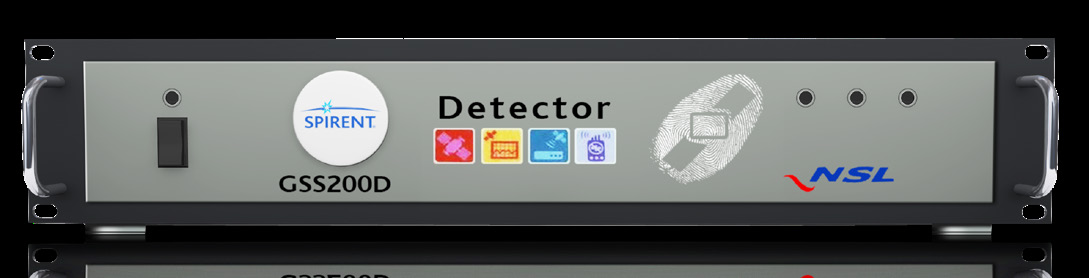
GNSS radio-frequency interference has become one of the most serious operational threats facing modern airports: jamming and spoofing incidents now occur daily across the Middle East, and satellite navigation underpins everything from RNAV/RNP approach procedures to GBAS and SBAS augmentation services. The Spirent GSS200D is a dedicated interference detection and analysis solution that builds a complete, evidence-grade picture of RF interference activity at a site of interest. The rack-mounted detector — co-developed with GNSS-integrity specialist NSL — continuously monitors the GNSS bands 24/7; when RFI is detected in one or both monitored frequencies it captures the interference data and sends an encrypted event record to PT Cloud, Spirent's secure cloud platform.
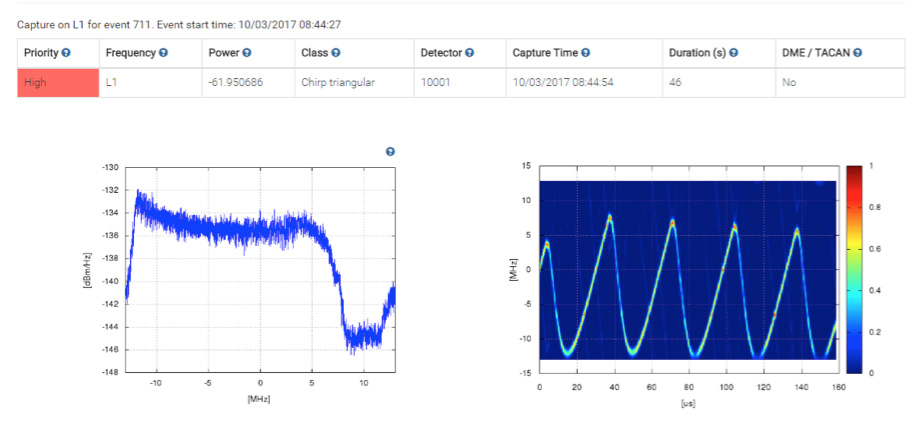
Each event is automatically characterised by type, so unintentional interference can be distinguished from deliberate jamming, and ranked by its likely impact on GNSS services so operators can prioritise real threats; email alerts can notify staff almost instantaneously. Every event is logged with its spectrum and spectrogram plus duration, power, type and priority, enabling monitoring over time and in-depth trend analysis. Two variants are published: GSS200D GPS GLO L1 for critical infrastructure, monitoring GPS, Galileo, GLONASS and QZSS in the L1 band; and GSS200D GPS L1 L5, designed specifically for civil aviation and SBAS/GBAS stakeholders, monitoring GPS/Galileo L1 and L5 (E5a) together with SBAS signals (WAAS, EGNOS, MSAS, GAGAN, SDCM).
The aviation variant applies detection criteria aligned to the ICAO Annex 10 interference mask for GPS L1 and the EUROCAE Galileo MOPS for E5a, and identifies pulsed DME/TACAN RFI — essential at airports where DME transponders operate adjacent to the L5 band. For GCC airports, air navigation service providers and regulators deploying GBAS ground stations or investigating recurring GPS outages, the GSS200D supports site-selection surveys, continuous monitoring and the quantified evidence needed to correlate navigation anomalies with real interference events. Captured RFI can additionally be re-synthesised and replayed on Spirent's PT TestBench (available separately) to test receiver resilience and develop countermeasures.
Technical specifications.
| Function | 24/7 automated GNSS RF interference detection, capture and analysis |
| Monitored bandwidth — GPS L1 | 1575.42 MHz centre; 16 MHz (±8 MHz, 3 dB) on GPS GLO L1 variant, 20 MHz (±10 MHz) on GPS L1 L5 variant |
| Monitored bandwidth — GLONASS L1 | 1602 MHz centre; 9 MHz (±4.5 MHz, 3 dB) |
| Monitored bandwidth — GPS L5 | 1176.45 MHz centre; 20 MHz (±10 MHz) |
| Event characterisation | Automatic interference typing (unintentional interference vs jamming) and priority ranking by likely impact on GNSS services |
| Event records | Spectrum and spectrogram with time, frequency, duration, power, type and priority per event |
| Supported bands — GPS GLO L1 variant | GPS / Galileo / GLONASS / QZSS L1 |
| Supported bands — GPS L1 L5 variant | GPS / Galileo L1 and L5 (E5a); SBAS (WAAS, EGNOS, MSAS, GAGAN, SDCM) |
| Alerting | Near-instantaneous email notification on event detection (user-selectable) |
| Data management | Encrypted event upload to Spirent PT Cloud; secure authenticated web-browser access with analytics, visualization and trend analysis |
| Mitigation support | Captured RFI events can be re-synthesised and replayed on Spirent PT TestBench to test receivers (available separately) |
| RFI detection basis — GPS GLO L1 variant | Calibration level, with absolute power |
| RFI detection basis — GPS L1 L5 variant | GPS L1: ICAO Annex 10 interference mask; GPS L5: EUROCAE Galileo MOPS for E5a; DME/TACAN pulsed RFI identification |
| Deployment form factor | Rack-mount field detector unit installed at the site of interest, paired with the secure PT Cloud data server |
Available variants.
Use cases.
- ›GBAS/SBAS ground-station site selection and continuous RFI monitoring
- ›Airport and ANSP investigation of recurring GNSS outages and jamming events
- ›Regulatory spectrum-protection monitoring and interference evidence gathering
- ›Critical-infrastructure GNSS timing/positioning protection (power grids, telecoms, ports, rail)
Replacements & compatible alternatives.
Comparable Air Traffic Control & Navigation Aids from other suppliers. Cross-shop on specs — confirm exact fit and compatibility with the supplier before specifying.