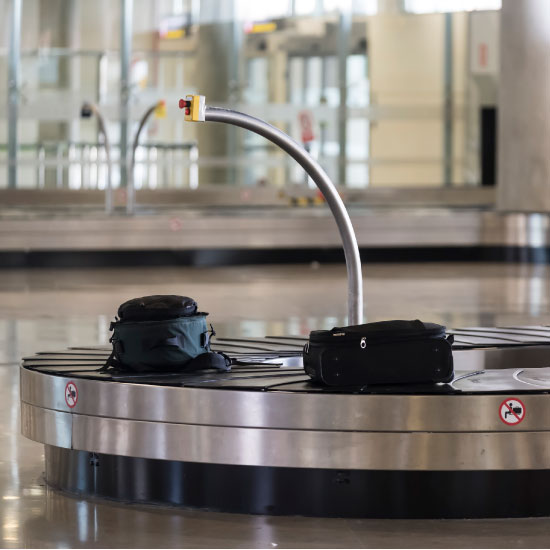

FLEET Bag
Autonomous guided vehicle system that replaces fixed conveyors and sorters with a scalable fleet of single-bag runners.
FLEET Bag is Vanderlande's autonomous vehicle-based baggage logistics platform, built for airports that need flexibility the physical constraints of fixed conveyors cannot provide. Each runner — a compact, autonomous guided vehicle — carries a single bag and independently navigates the most efficient route through the baggage hall, handling screening feed, buffering, and delivery to the correct make-up position without any fixed sortation infrastructure.
The absence of fixed-layout conveyors and sorters is the defining design choice: routes can be reprogrammed without civil works, new vehicles added in hours rather than weeks, and make-up positions reassigned to accommodate rebridged flights or seasonal schedule shifts. This makes FLEET Bag particularly compelling for phased terminal renovations where sections of the baggage hall must stay operational while others are rebuilt, and for facilities hosting major events that require temporary peak-capacity uplift.
During trials at Rotterdam The Hague Airport, FLEET Bag operated as a production system; Dallas/Fort Worth tested the platform airside. Energy consumption is up to 50% lower than comparable conventional conveyor systems — the runners operate on battery power with no continuously-running belt drive infrastructure.
For regional airports, greenfield builds, or any hub evaluating a long-term exit from legacy fixed-system maintenance liabilities, FLEET Bag represents the direction the industry is moving: a baggage hall defined by software, not steel.
Technical specifications.
| Vehicle type | Autonomous guided vehicle (single-bag runner) |
| Energy saving vs conventional BHS | Up to 50 % |
| System flexibility | Routes and make-up positions software-reconfigurable |
| Redundancy | No single-point-of-failure fixed-infrastructure dependency |
| Reference deployments | Rotterdam The Hague Airport (production), Dallas/Fort Worth (trials) |
Use cases.
- ›Greenfield terminal builds seeking to eliminate fixed conveyor and sorter civil-works constraints
- ›Phased renovation projects requiring live baggage operations alongside active construction zones
- ›Regional airports wanting scalable capacity (add vehicles, not conveyors)
- ›Peak-period and major-event temporary capacity augmentation
- ›Airports pursuing long-term energy and maintenance cost reduction targets
Replacements & compatible alternatives.
Comparable Baggage Handling Systems from other suppliers. Cross-shop on specs — confirm exact fit and compatibility with the supplier before specifying.