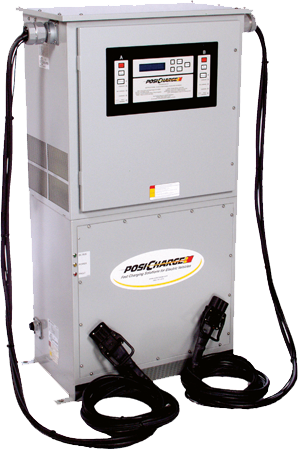
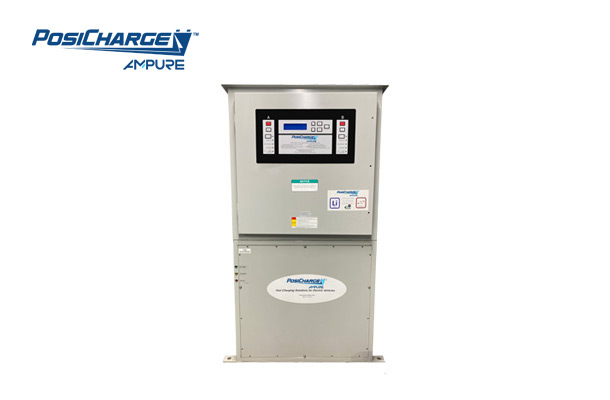
PosiCharge DVS 300 / 400 Dual-Vehicle Fast Charger
Stand-alone 30-40 kW charger: two eGSE vehicles at 250 A, or one at 500 A
The PosiCharge DVS 300 / 400 is a stand-alone dual-vehicle fast charger for electric ground support equipment: it charges two vehicles simultaneously at up to 250 A each, or one vehicle twice as fast at up to 500 A. An integrated AC-to-DC power server means no separate rectifier cabinet, which the OEM credits with significantly lower up-front installation and ongoing utility costs versus other fast chargers.
The DVS sits at the decision point most electrifying ramp operations reach after their first eGSE order: one charger per vehicle multiplies electrical installations across the apron, while a full multi-port system can be oversized for a gate cluster. A dual-port unit that also doubles as a 500 A fast charger covers both duty cycles. It spans a 24-96 V battery voltage range, and the Smart Battery Monitor and Identification Device (BMID) lets different vehicles and batteries charge on the same unit. Critically for fleets mid-transition on battery chemistry, the DVS is capable of CAN communication with lithium batteries through the PosiCharge CAN protocol — one charger serving both lead-acid legacy assets and incoming lithium equipment.
The DVS 300 delivers 30 kW and the DVS 400 delivers 40 kW (a 33 kW DVS 330 is also published), from 480 or 600 VAC three-phase input at a 0.96 power factor and 90% efficiency with a 40 A / 32 A full-load draw. Euro and Burton output connector options are available, and the unit can share power with the jet bridge or other devices to cut installation cost.
Charging safety uses both temperature compensation and temperature foldback to control battery temperature during fast charging, plus automatic start/stop, anti-arcing disconnect and auto thermal shutdown. The NEMA 3R enclosure is rated for all-weather outdoor operation with a published operating range to +50°C — a workable envelope for GCC apron summers.
Technical specifications.
| Full-load amp draw | 40 A @480 V / 32 A @600 V |
| Max circuit breaker rating | 50/40 A (DVS 300); 70/60 A (DVS 400) |
| Efficiency | 90 % |
| Output power | 30 (DVS 300) / 40 (DVS 400) kW |
| Max output current (dual mode) | 250 A |
| Max output current (single mode) | 500 A |
| Charge ports | 2 (or single vehicle at double rate) |
| Input power | 480 / 600 VAC, 3-phase |
| Lithium battery support | CAN communication via PosiCharge CAN protocol |
| Output connectors | Euro and Burton options |
| Communication port | RS232 |
| Battery voltage range | 24-96 V |
| Power factor | 0.96 |
| Battery identification | Smart Battery Monitor and Identification Device (BMID) |
| Enclosure rating | NEMA 3R (outdoor) |
| Operating temperature | -40 to +50 °C |
| Dimensions (H×W×D) | 60 × 32.4 × 21.9 in |
| Weight | 905 (DVS 300) / 915 (DVS 400) lb |
Available variants.
Use cases.
- ›Gate-area eGSE charging
- ›Baggage tractors and belt loaders
- ›Two-vehicle simultaneous charging
- ›Single-vehicle 500 A fast charge
- ›Mixed lead-acid / lithium fleets in chemistry transition
Replacements & compatible alternatives.
Comparable Ground Support Equipment (GSE) from other suppliers. Cross-shop on specs — confirm exact fit and compatibility with the supplier before specifying.