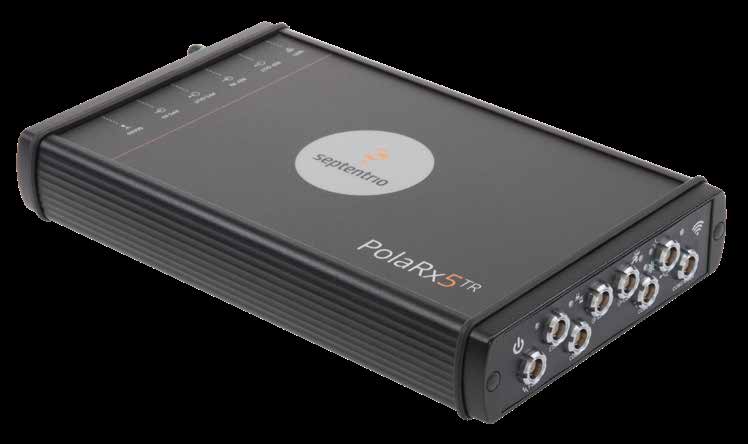
Septentrio PolaRx5TR GNSS Time and Frequency Transfer Receiver
CGGTTS V2E-compliant GNSS timing reference receiver with calibrated PPS input, 5 ns 1PPS accuracy and AIM+ interference monitoring
The PolaRx5TR is the timing member of Septentrio's PolaRx5 reference-receiver family, dedicated to ultra-precise time and frequency transfer and fully compliant with recommendations CCTF 4 and 5 (2015) of the Consultative Committee for Time and Frequency. It is built around the GReCo4 multi-constellation tracking processor with 544 hardware channels assigned on-the-fly to all visible GPS, GLONASS, Galileo, BeiDou and NavIC signals, with P-code tracking on L1/L2 to avoid C/A-P biases. Timing performance is engineered at the physical layer: code-carrier bias is zero by design, inter-frequency code bias is below 10 ns, code measurement precision below 0.5 ns, phase measurement precision below 5 ps, and 1 PPS output accuracy is 5 ns with under 2 ns rise time. A dedicated calibration circuit continuously measures and compensates the delay between the PPS input and the internal time reference to 20 ps precision, and CGGTTS V2E files for GPS, GLONASS, Galileo and BeiDou are generated on the receiver itself for automated FTP transfer.
GNSS time is only as trustworthy as the RF environment it is received in, and the PolaRx5TR carries the same AIM+ Advanced Interference Monitoring and Mitigation system as the rest of the family: an onboard spectrum analyser with adaptive filtering that monitors, flags and mitigates narrowband and wideband interference, jamming and spoofing, enabling operation even near chirp jammers, complemented by Galileo OSNMA authentication support. For airports and air navigation infrastructure — where surveillance, communications, recording and network systems increasingly discipline their clocks to GNSS — this pairing delivers UTC-traceable time transfer with continuous visibility of the interference that could silently degrade timing.
Deployment mirrors the reference-station family: 10 MHz reference input and output, monitored 1 PPS input, PPS output up to 100 Hz, four hi-speed serial ports, 100 Mbps Ethernet with Power-over-Ethernet, integrated Wi-Fi, secured web UI, and 16 GB onboard logging with up to 48 logging jobs in SBF, RINEX, BINEX, CGGTTS and NMEA. The IP65-rated housing measures 235 × 140 × 37 mm, weighs 940 g, consumes 3–5 W from a 9–30 VDC input and operates from −40 °C to +65 °C.
Technical specifications.
| Hardware channels | 544 (GReCo4 tracking processor) |
| Constellations tracked | GPS (P-code L1/L2, L2C), GLONASS, Galileo, BeiDou, NavIC — all visible signals |
| Timing compliance | CGGTTS V2E on board and on PC; compliant with CCTF recommendations 4 and 5 (2015) |
| Code-carrier bias | 0 by design |
| Inter-frequency code bias | < 10 ns |
| Code measurement precision | < 0.5 ns |
| Phase measurement precision | < 5 ps |
| PPS-in delay calibration precision | 20 ps |
| 1 PPS out accuracy / rise time | 5 ns / < 2 ns |
| Interference monitoring | AIM+ monitors, flags and mitigates narrow/wideband interference, jamming and spoofing; spectrum analyser; operation near chirp jammers |
| Anti-spoofing | Galileo OSNMA support |
| Max raw data rate | 100 Hz |
| Timing I/O | 10 MHz REF IN (50 Ω) and REF OUT (1.1 Vpp sine), monitored 1 PPS IN, 5 V PPS OUT up to 100 Hz |
| Data formats | CGGTTS V2E, SBF, RINEX v2.x/3.05/4.00, BINEX, NMEA v2.30/v4.10, RTCM MSM (optional) |
| Interfaces | 4 hi-speed serial, 100 Mbps Ethernet (PoE), Wi-Fi 802.11 b/g/n, USB device + USB host, HTTP/HTTPS, FTP/SFTP, NTRIP |
| Onboard logging | 16 GB, up to 48 logging jobs |
| Input voltage | 9–30 VDC |
| Power consumption | 3–5 W |
| Operating temperature | −40 to +65 °C |
| Dimensions | 235 × 140 × 37 mm |
| Weight | 940 g |
Certifications.
Use cases.
- ›UTC-traceable timing for airport surveillance, communications and network infrastructure
- ›GNSS timing integrity monitoring with interference detection
- ›National timing laboratories and time/frequency transfer between sites
- ›Synchronisation of scientific instrument networks
Replacements & compatible alternatives.
Comparable Air Traffic Control & Navigation Aids from other suppliers. Cross-shop on specs — confirm exact fit and compatibility with the supplier before specifying.